The dinosaurs outside your window
Are Birds Dinosaurs? The Evidence Explained
Short answer
Yes. Birds are living dinosaurs, specifically one branch of theropods. Saying that birds descended from dinosaurs is true, but it can suggest that they left the group. In evolutionary classification, descendants remain within the branches from which they evolved.
A branch stays part of its tree
A sparrow can be a bird, a theropod and a dinosaur at the same time. These are nested groups, not competing labels. A simple path through the tree is Dinosauria → Theropoda → the lineage containing birds. That path does not say every theropod was a bird.
The Natural History Museum places bird origins among small theropods. T. rex was another theropod, on a different branch. Chickens and tyrannosaurs have shared ancestors; chickens are not miniature descendants of T. rex.
The case rests on a combination of features
Researchers compare many anatomical characters across fossils and living animals. A wishbone, the structure of the wrist, air-filled spaces in parts of the skeleton, eggs and feathers all contribute to the picture. No single familiar-looking feature settles the whole family tree.
The University of California Museum of Paleontology describes shared skeletal features in detail. Its older discussion predates many feather discoveries, so the anatomical explanation should be read alongside later fossil evidence rather than as a current catalogue of what is known.
| Evidence | Why it matters | What it does not mean |
|---|---|---|
| Shared skeletal features | Allow comparisons across related groups | One hollow bone identifies a bird |
| Feathers on non-bird dinosaurs | Feathers originated before modern birds | Every feathered dinosaur could fly |
| Early birds with teeth and long tails | Show combinations absent in living birds | A fossil must be the direct ancestor of a living species |
| Brooding and egg evidence | Adds reproductive similarities | All dinosaurs raised young in the same way |
Archaeopteryx makes the transition tangible
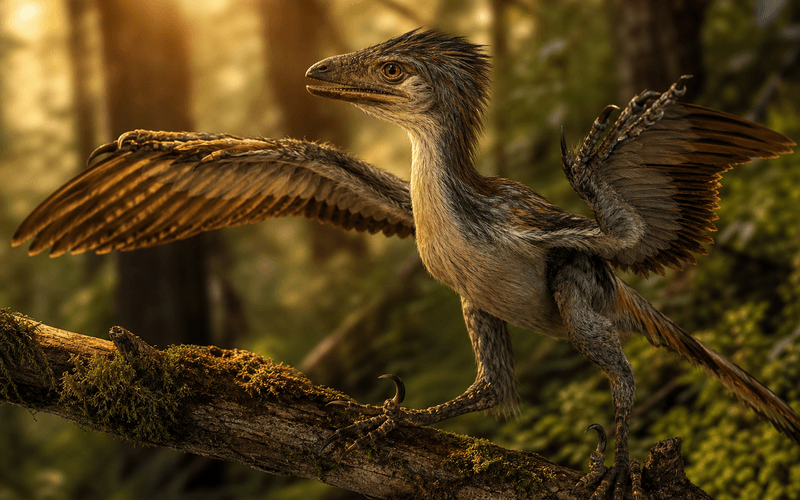
Archaeopteryx combined feathered wings with teeth, clawed fingers and a long bony tail. It helps us understand early bird anatomy without requiring it to be the single ancestor of all later birds. Evolution produces branching relatives, and the fossil record samples some of them.
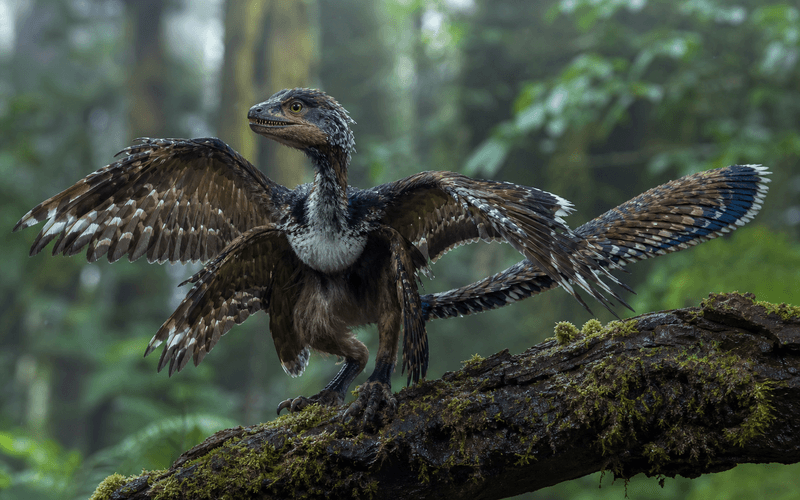
Microraptor offers another useful comparison: it had long feathers on its forelimbs and hindlimbs but belongs outside modern birds. Our guide to dinosaur feathers explores why feathers are evidence about anatomy and evolution, not a synonym for powered flight.
Why “bird-hipped” can mislead
The traditional dinosaur groups include Ornithischia, often translated as “bird-hipped,” and Saurischia, “lizard-hipped.” Despite those names, birds belong within the theropod branch traditionally placed in Saurischia. The labels describe features used historically, not the ancestry a modern reader might infer from them. The National Park Service’s classification guide makes this distinction explicit.
What survived the end-Cretaceous extinction?
Birds are the only dinosaur lineage alive today. Other dinosaur branches disappeared in the extinction around 66 million years ago. This is why “non-avian dinosaurs became extinct” is more precise than “all dinosaurs became extinct.” It also avoids a false choice: the catastrophe was real, and dinosaur descendants still live around us.
For the environmental catastrophe itself, read why the non-avian dinosaurs disappeared. Here the key conclusion is about membership in a family tree: a pigeon remains a dinosaur even though it looks and lives very differently from its distant extinct relatives.
Questions and answers
Are crocodiles dinosaurs too?
No. Crocodilians and dinosaurs belong to the larger archosaur group, but crocodilians lie outside Dinosauria.
Does a bird need to fly to be a dinosaur?
No. Flight is not the test of membership. Flightless birds remain birds and therefore dinosaurs.