— field note No. 3 —
Which dinosaur was the biggest?
Short answer
Ask a palaeontologist which dinosaur was the biggest and you’ll get a question back: longest, tallest or heaviest? Sauropods, the long-necked plant-eating giants, win all three contests. For sheer weight the names you hear most are Argentinosaurus and Patagotitan. Crowning a champion is hard, though. Many giants are known from a handful of bones, and the estimates are revised again and again.
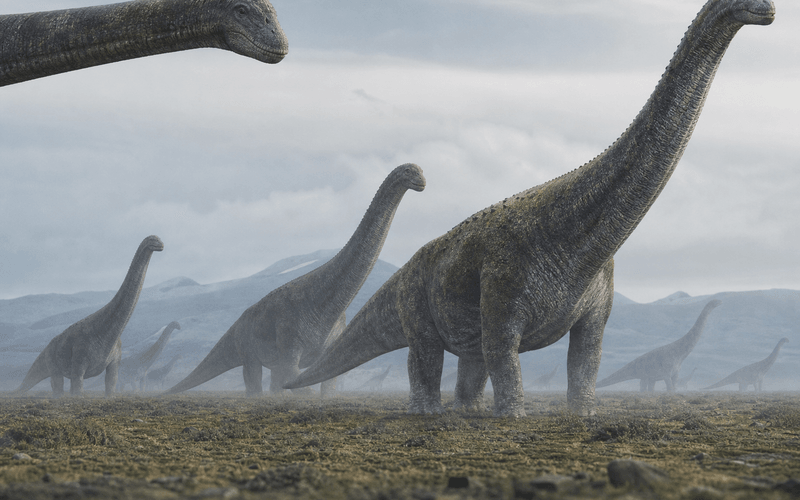
What does “biggest” mean?
Length, height and weight are three separate contests, with different winners. Argentinosaurus is famous for its weight, usually put at 65–80 tonnes, even though it is known from only a few bones. A dinosaur with a longer tail could beat it on length and still be far lighter.
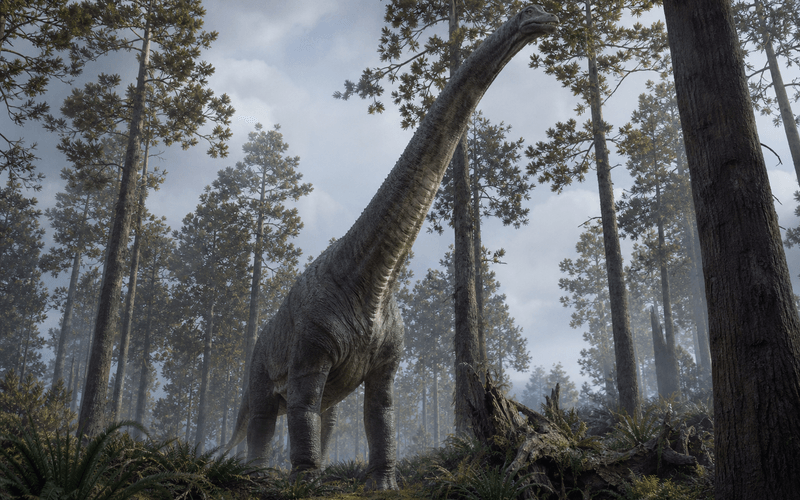
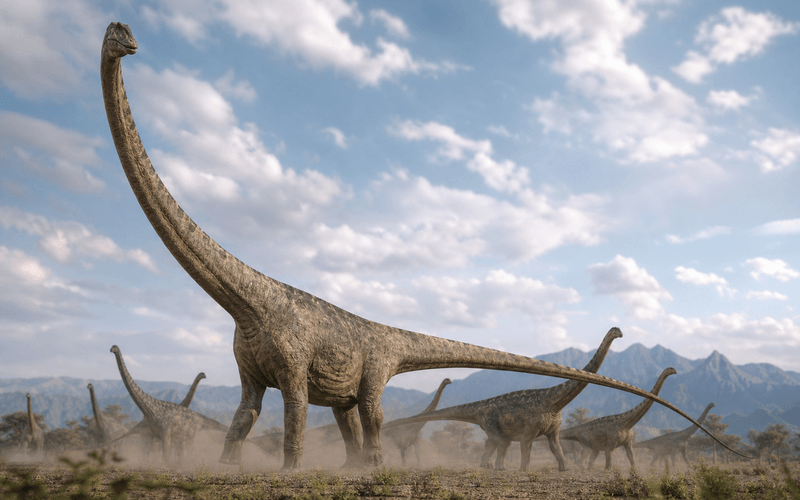
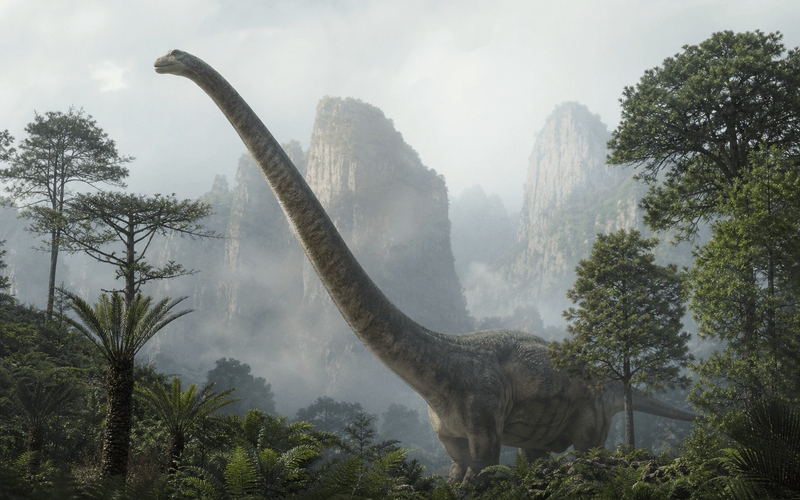
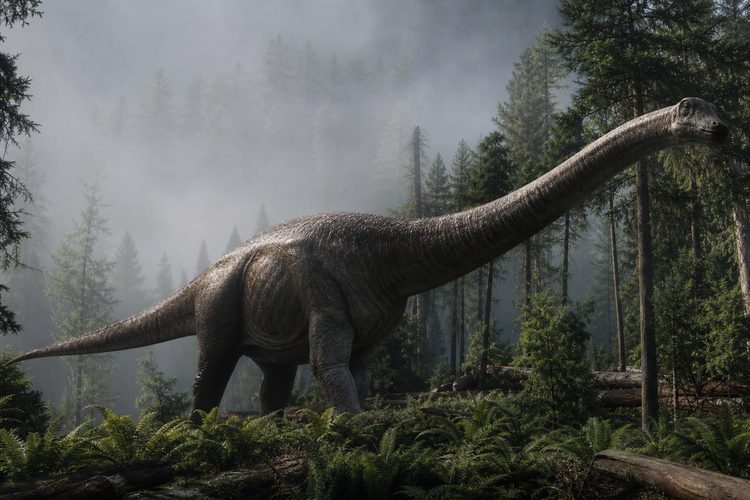
In Diplodocus, most of the length went into neck and tail. Brachiosaurus scored on height: its front legs were longer than its hind legs, so its back sloped up towards the shoulders like a giraffe’s. Mamenchisaurus stood out for a neck that was remarkably long even by sauropod standards. Say “big” without saying how, and you have said very little.
Why the estimates differ
A complete skeleton of a giant is a rare stroke of luck. Usually a palaeontologist gets a few vertebrae and some leg bones. The rest is filled in from relatives, and the weight is worked out from the thickness of the bones or the volume of a body model. Hence all the dinosaurs that “slim down”. Patagotitan, known far more completely than Argentinosaurus, was first put at almost 70 tonnes and later at about 55–57.
Even close relatives could be built very differently: Apatosaurus was much bulkier than Diplodocus, though about as long. A lot also depends on how much muscle a researcher “puts on” the skeleton. And sometimes there is nothing left to check. In 2023 Bruhathkayosaurus from India was estimated at more than a hundred tonnes, but its bones crumbled away before anyone could study them, so the figure is treated with caution.
Which was the biggest predator?
Three contenders here: Tyrannosaurus, Spinosaurus and Giganotosaurus. The longest was probably Spinosaurus, at about 14 metres and 7–7.5 tonnes. The heaviest reliably measured is Tyrannosaurus, whose largest known specimen weighed about 8.8 tonnes. Giganotosaurus runs it close, but its remains are less complete.
There is another snag: which individual do you count? A youngster, a fully grown veteran and a specimen rebuilt from fragments are hard to compare. Besides, only a tiny fraction of all the animals that ever lived has been found, so the real record holders are unlikely to be among them. A 2024 calculation suggests the largest Tyrannosaurus may have been more than one and a half times heavier than the largest one found.
How to read the figures in the catalogue
The numbers on the cards are there to give you a sense of scale: this one was the size of a person, that one as long as three buses parked nose to tail. Every value is approximate. A range is more honest than a single number, but even its limits shift when new finds turn up, as they did for Patagotitan.
Questions and answers
Which dinosaur was the heaviest?
The main contenders are Argentinosaurus (roughly 65–80 tonnes) and Patagotitan (about 55–57 tonnes after the latest recalculation). Argentinosaurus’s skeleton is too incomplete to name it champion with confidence.
Which dinosaur was the longest?
Possibly Supersaurus, a relative of Diplodocus. It used to be put at 33–34 metres; a 2021 reconstruction gives at least 39. So far that figure has only been presented in a conference talk, so it is too early to call it final.
What was the biggest predatory dinosaur?
By length, probably Spinosaurus, at about 14 metres. By weight, Tyrannosaurus: about 8.8 tonnes for the largest specimen found. Giganotosaurus is not far behind.
Why can’t we know a dinosaur’s exact weight?
You can’t put a dinosaur on the scales. Soft tissue almost never survives, skeletons are incomplete, and weight has to be calculated from indirect evidence.