— field note No. 4 —
Why did the dinosaurs die out?
Short answer
Sixty-six million years ago an asteroid about ten kilometres across slammed into a shallow sea off what is now Mexico. Dust blotted out the sky, plants were cut off from the light, and within a short time every dinosaur except the birds was gone. The birds hardly escaped unscathed either: many of their ancient groups did not survive the catastrophe.
Not all of them died out
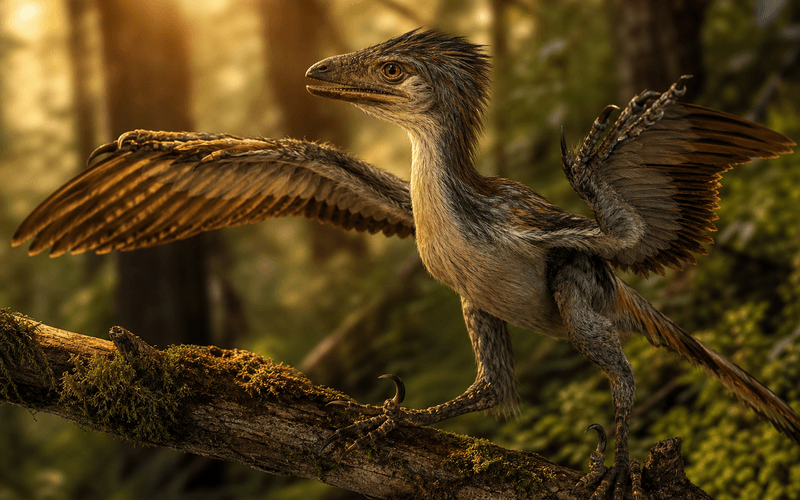
First, a correction: the dinosaurs didn’t die out. The sparrow outside your window is their direct descendant, and in evolutionary terms birds belong to the dinosaurs just as bats belong to the mammals. That is why palaeontologists put it more precisely: it was the non-avian dinosaurs that disappeared. Where that kinship comes from is the subject of our field note on feathers.
The disaster reached far beyond the dinosaurs. Pterosaurs vanished, Pteranodon among them, and so did the great sea reptiles, including Mosasaurus. They died alongside the dinosaurs, but that did not make them dinosaurs.
What the asteroid did
The scar of the impact is the Chicxulub crater on Mexico’s Yucatán Peninsula. Traces of the collision turn up worldwide: a thin layer at the Cretaceous–Palaeogene boundary holds asteroid material and mineral grains crumpled by colossal pressure. In 2024, ruthenium isotopes in that layer revealed the visitor’s origin: a carbonaceous asteroid formed beyond the orbit of Jupiter.
The damage spread far beyond the impact site. According to calculations published in 2023, the chief culprit was extremely fine rock dust, which hung in the atmosphere for years together with soot and sulphur and shut down photosynthesis for almost two years. The same model has surface temperatures falling by as much as 15 °C. Plants and plankton died first, then the animals that ate them, then the predators.
What about the volcanoes?
At around the same time, in what is now India, the Deccan Traps were erupting: vast lava fields of a kind the Earth no longer produces. Volcanic gases did change the climate. Data from 2024 show that a large eruption some 30,000 years before the impact cooled the planet by at least 5 °C. Yet temperatures were back to normal 20,000 years before the asteroid struck. That is why volcanoes are now given a secondary role, though the argument isn’t over.
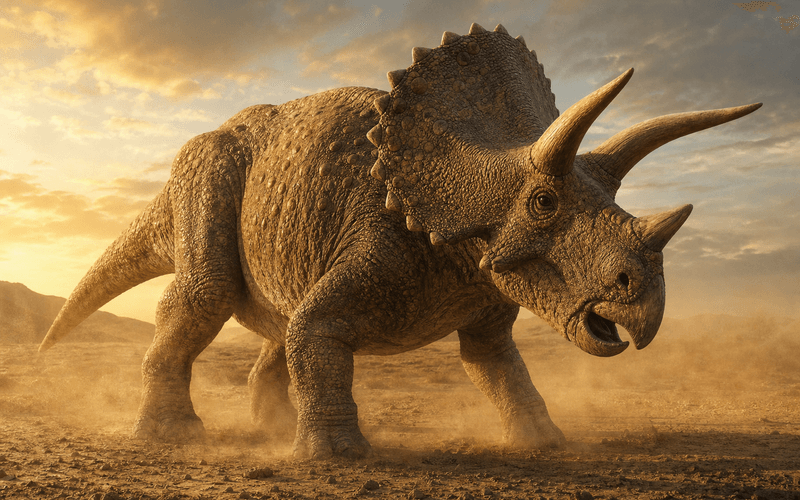
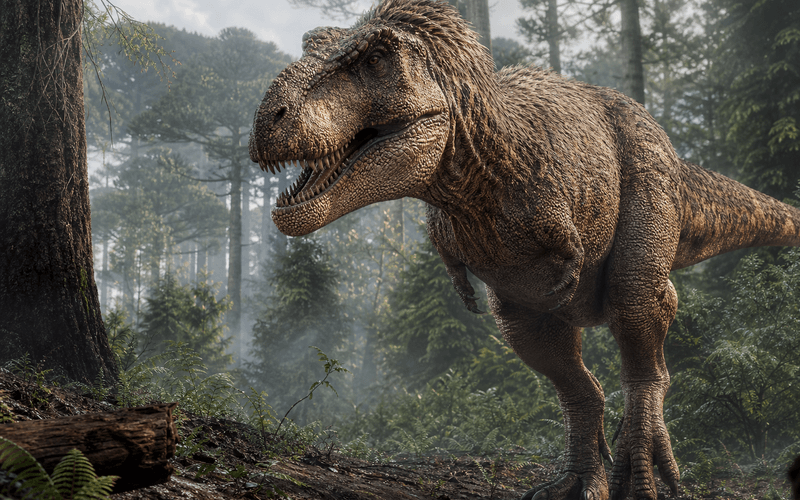
It used to be thought that the dinosaurs were already in decline. Studies from 2025 say the opposite. There only seem to be fewer species because so little rock of that age has survived, and in New Mexico rich and varied dinosaur communities lived on until the last few hundred thousand years before the impact. Tyrannosaurus and Triceratops were no failures. The world simply changed too fast.
Why some survived and others didn’t
There was no single recipe for survival. Some were saved by small size, others by eating almost anything, by living in water or by lying low in shelter. Everyone suffered losses, birds and mammals included: both lost a great many lineages.
A group surviving doesn’t mean all its species did. The lineages that came through slowly gave rise to new forms and filled the emptied planet again. Nor did the story of the dinosaurs end there. It carries on every morning at the nearest bird feeder.
Questions and answers
Did all the dinosaurs die out?
No. The non-avian dinosaurs disappeared, but some birds survived the catastrophe, and every bird alive today descends from them.
Where is the Chicxulub crater?
On the Yucatán Peninsula in Mexico. Part of it lies under land, part under the seabed.
Was it the asteroid or the volcanoes?
The asteroid. The Deccan eruptions did change the climate, but 2024 data show it had recovered before the impact, so the volcanoes are given a secondary role.
Why did crocodiles and mammals survive?
There is no one reason that fits them all. Individual lineages were helped by a mix of lifestyle and diet: small size, undemanding tastes, shelter, water.