— field note No. 1 —
Tyrannosaurus: what it was really like
Short answer
Twelve metres from snout to tail tip, a skull as long as a writing desk and teeth that crushed bone. Tyrannosaurus lived in western North America 68–66 million years ago, and its skeleton is better known than that of any other large predatory dinosaur. The bones say much less about its voice, colouring and habits, and that is where most of the guesswork lies.
Tyrannosaurus without the make-up
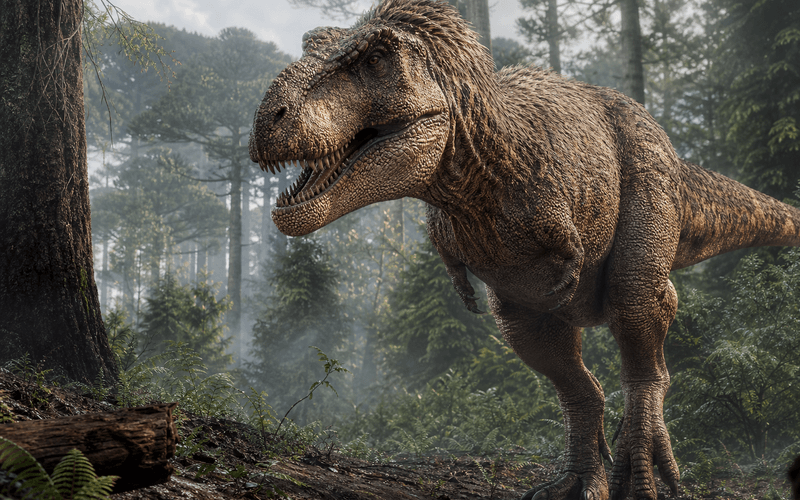
The screen Tyrannosaurus roars non-stop and lunges at anything that moves. The real one has to be pieced together bone by bone, quite literally. The skeleton tells us what it looked like and how much it weighed, and tooth marks on other animals’ bones give away what it ate. Behaviour is harder. That is rebuilt from indirect clues: healed wounds, the build of its sense organs, the habits of predators alive today.
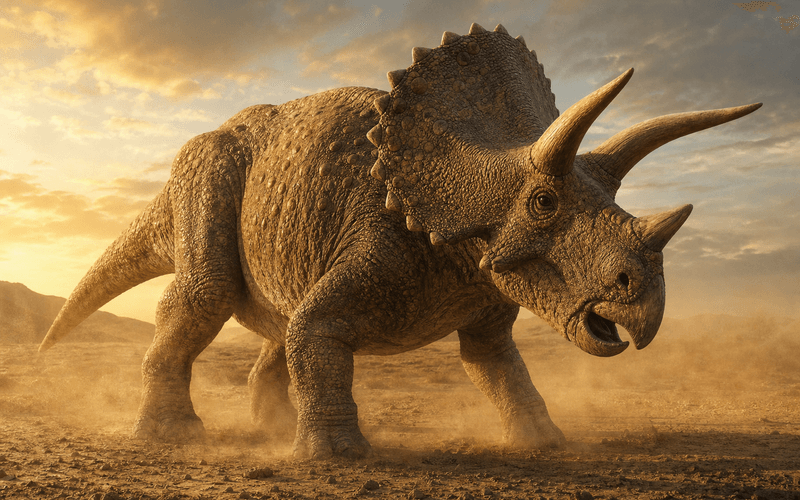
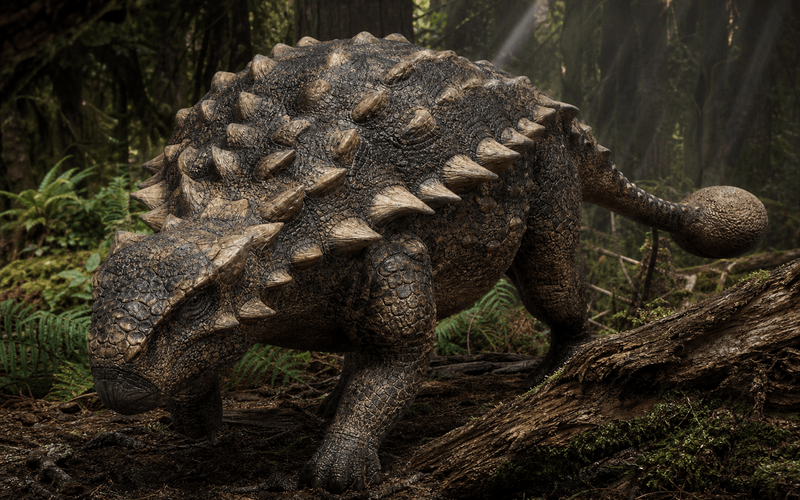
Its neighbours were horned Triceratops and Ankylosaurus in its suit of bony armour. No predator of its day could match Tyrannosaurus, yet beside the sauropods it was a lightweight: Argentinosaurus was several times heavier. The two never met. Argentinosaurus lived much earlier, and on another continent.
Length, weight and bite
A grown Tyrannosaurus stretched to about twelve metres, roughly the length of a city bus, and a good share of that was tail, a counterweight to the heavy head. The skull reached a metre and a half; the biggest teeth, root included, up to 30 centimetres. It took its time getting there. Growth rings in its bones (a study from 2026) suggest it reached full size only at around 35 to 40 years of age.
Nobody can put an extinct animal on the scales, so its mass is calculated from the bones and from models of its body volume. For the adults found so far the results range from 6 to 9 tonnes, and the record holder is “Scotty” from Canada, at about 8.8 tonnes. The 15 tonnes you may also come across comes from a 2024 statistical model: that is what the very largest tyrannosaurs might have weighed, animals nobody has yet found. The bite is a similar story. Some 35,000 newtons is a calculation. It gives the order of magnitude, not a reading off a gauge.
Hunter or scavenger?
Tyrannosaurus wrote its menu on other animals’ bones, in tooth marks. Some of those wounds had healed. So it went after live prey, and the prey sometimes got away.
It hardly turned its nose up at carrion, though. Lions and hyenas both hunt and help themselves to other animals’ leftovers, and there is no reason to think a predator weighing several tonnes was any fussier. The old “hunter or scavenger” argument simply asks the wrong question.
Its thick teeth could take enormous loads and splinter bone, and a superb sense of smell helped it find food. How it picked a victim, crept up and struck is another matter. The bones have kept no record of that, so any detailed hunting scene is a reconstruction.
Who lived next door
At the end of the Cretaceous an inland sea cut western North America, Laramidia, off from the east. River valleys, floodplains and forests made it a busy, lived-in country rather than an empty arena for battling giants. A smaller predator lived here too. Small skeletons from the same rock layers were long taken for teenage T. rex, but in 2025 two independent studies showed they belong to a separate genus, Nanotyrannus: a slender hunter weighing up to 700 kilograms.
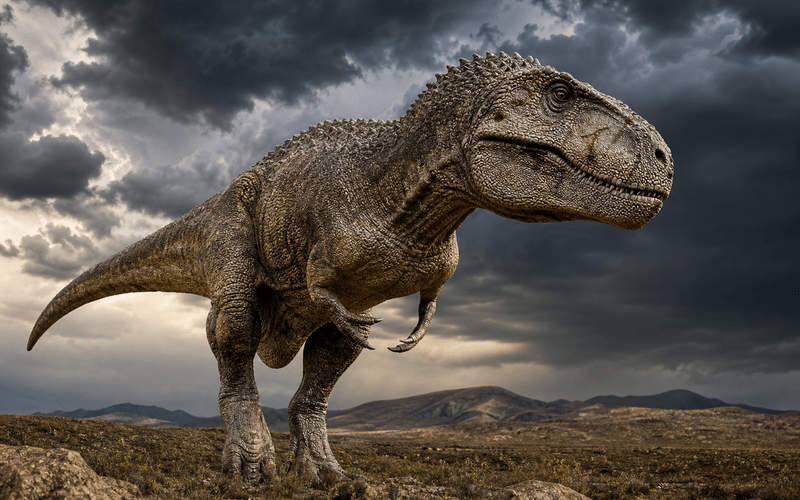
Some other celebrities Tyrannosaurus missed altogether. South America’s Giganotosaurus lived far earlier, so the two can only be measured against each other on paper. And earlier conclusions about how young T. rex grew up will now have to be checked all over again.
What not to believe in the films
Tyrannosaurus’s speed is worked out from its skeleton and computer models, and the answer each time depends on which muscles are “fitted” to the bones. The jeep chase plays no part in these calculations. It is a scene, not a measurement.
Nobody has yet convincingly explained the short but muscular arms. The permanent toothy snarl is more of a film convention: according to a 2023 study, when the jaws of large predatory dinosaurs were shut, their teeth were covered by something like lips, as in lizards, although not everyone agrees. Skin colour and voice are harder still to reconstruct, and there the artist has a free hand.
Questions and answers
Was Tyrannosaurus the biggest dinosaur?
No. It is the heaviest reliably measured predatory dinosaur, but the sauropods, long-necked plant-eating giants, were both longer and several times heavier.
When did Tyrannosaurus rex live?
68–66 million years ago, at the very end of the Cretaceous. Its time ended with the mass extinction at the Cretaceous–Palaeogene boundary.
What were its short arms for?
Nobody knows. They were muscular, and several explanations have been put forward, but none has been proven.
Could Tyrannosaurus outrun a car?
Depends on the car. Estimates of its speed vary, and none of them is based on film chases.