Colour beyond the bones
What Colour Were Dinosaurs? Evidence and Uncertainty
Short answer
Scientists have reconstructed aspects of colour in a small number of exceptionally preserved dinosaurs. Pigment-bearing structures and their distribution can reveal dark, reddish or iridescent coverings and body patterns. Most dinosaur fossils do not preserve that evidence, so a complete colour scheme often remains an artistic reconstruction.
The clue is smaller than a feather
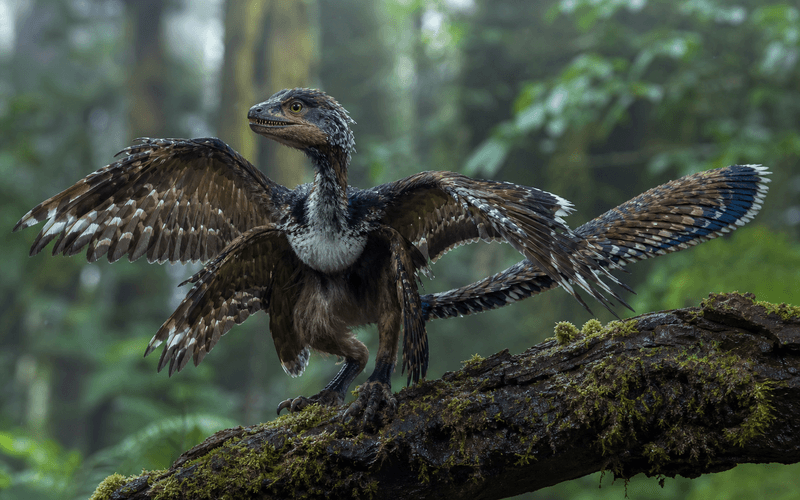
Melanosomes occur in the skin and feathers of living animals. In suitable fossils, microscopic structures and chemical evidence can be compared with those of living species. That comparison can constrain the pigments or optical arrangements present in an extinct animal.
The Natural History Museum of Utah explains both the breakthrough and its limits: some colours are more accessible to these methods than others. A fossil is not a colour photograph, and the absence of a detectable pigment does not automatically establish a white patch.
A pattern can tell us more than a paint swatch
A particularly informative Psittacosaurus specimen preserves evidence of a darker upper surface and lighter underside. Researchers reconstructed the animal and tested how its pattern related to shadows under different lighting. The University of Bristol’s account of that research explains the inference that its countershading suited diffuse light, such as a forest environment.
That is a chain of reasoning: preserved pattern → reconstructed body → lighting comparison → habitat hypothesis. Each step adds assumptions. The result is more useful when those steps remain visible than when reduced to “this dinosaur was brown and lived in a forest.”
Read a reconstruction in layers
When a picture is described as scientifically informed, ask which parts come from the specimen and which complete a plausible living animal. A single reconstruction may combine several levels of confidence.
| Claim | Useful evidence | Main limitation |
|---|---|---|
| Pigment was present | Microscopic and chemical observations | Burial can alter the original material |
| A pattern crossed the body | Distribution of preserved pigment | Missing parts require reconstruction |
| A covering was iridescent | Preserved structures compared with living feathers | Appearance changes with angle and light |
| The whole animal had this exact palette | A complete reconstruction | Many colours and body regions may remain unknown |
Why most skeletons cannot answer the question
Bones usually tell us much more about proportions than surface colour. Even a superb skeleton can lack skin or feathers. Its present colour may come from minerals acquired during fossilization. A dark fossil bone is not evidence that the animal had dark skin.
This is why two responsible artists can paint the same dinosaur differently. They may agree on the skeleton and still have no direct evidence for the colour of its eyes or the pattern over its back. Our fossilization guide explains why different tissues leave different records.
What to look for in a dinosaur illustration
Start with the caption. Does it name a specimen or research paper? Does it distinguish a preserved pattern from an inferred one? Does it claim more than the evidence covers? Those questions are more revealing than whether the image looks realistic.
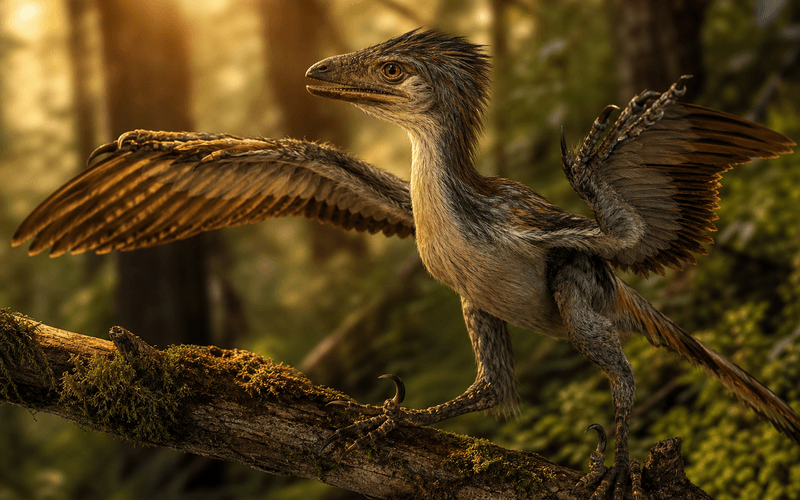
Compare Microraptor with Archaeopteryx, then read about the evidence for feathers. A convincing reconstruction can help us imagine an animal, but it should also make clear where imagination begins.
Questions and answers
Were all dinosaurs green or brown?
No single colour scheme applies to Dinosauria. Evidence from exceptional specimens reveals varied patterns, while the colours of most species remain poorly known.
Can scientists recover every original colour?
No. Preservation and the biology of different pigments limit what can be reconstructed. A partial result is still informative.